By Giacomo Tonti, Business Development Manager, Advantest Europe
The power semiconductor industry is navigating a period of significant evolution, driven by the rapid growth of key sectors such as electric vehicles (EVs), renewable energy systems, industrial automation, and energy storage infrastructure. Traditionally dominated by silicon-based devices like insulated-gate bipolar transistors (IGBTs) and metal-oxide-semiconductor field-effect transistors (MOSFETs), the sector is now seeing a structural shift toward wide-bandgap (WBG) semiconductors—in particular, silicon carbide (SiC) and gallium nitride (GaN). These materials offer performance advantages that address limitations inherent to silicon, especially in high-voltage, high-temperature, and high-frequency applications.
Although SiC and GaN remain more expensive and less established than traditional silicon devices, they are steadily displacing legacy solutions in applications where performance gains outweigh higher upfront costs. Market research consistently points to robust growth, with the SiC market expected to grow from USD 4.8 billion in 2026 to approximately USD 10.38 billion by 2030, according to Yole Group.
In sectors such as automotive—particularly electric vehicles—stringent efficiency, thermal, and reliability requirements make the advantages of WBG devices compelling. When paired with tightening energy-efficiency regulations and global EV adoption initiatives, these performance benefits increasingly justify the premium pricing associated with WBG technology.
Artificial intelligence (AI) is also driving growth in the power semiconductor industry. The continued increase of new data centers requires higher power efficiency, as well as higher power density requirements. SiC and GaN are increasingly used to improve power-conversion efficiency. In data centers, power supply units lose energy as heat when converting AC to DC. By reducing these losses, SiC and GaN devices allow hyperscalers to deliver more usable power density, increasing overall throughput. With increasing power demands straining existing grids, unlocking power efficiency is crucial to the ongoing growth of AI infrastructure.
Key Test Challenges for Power Devices
Although the industry's transition toward SiC and GaN enables faster switching speeds, higher operating temperatures, and improved efficiency compared with conventional silicon devices, these same advantages make these WBG materials more challenging to characterize and validate in production test environments. For example, their extremely fast switching transients demand measurement systems with much higher bandwidth and lower parasitic effects, while their higher voltage and current capabilities require test platforms capable of safely handling increased power levels without compromising measurement accuracy.
At the same time, the architecture of power devices themselves is evolving beyond discrete transistors. Highly integrated solutions such as intelligent power modules (IPMs) and intelligent power devices (IPDs) combine power transistors with gate drivers, protection circuits, sensors, and increasingly sophisticated digital control logic into a single package. The integration of digital IP cores into these devices blurs the traditional boundary between power semiconductor testing and system-on-chip testing. As a result, production testing must cover not only high-power analog characteristics but also digital functionality, communication interfaces, embedded memory, and built-in diagnostic features. This dual-domain testing often requires combining conventional mixed-signal ATE capabilities with specialized high-voltage power test instrumentation.
The convergence of WBG technologies and highly integrated power modules ultimately demands new testing strategies. Advanced methodologies—such as high-bandwidth capture, gate driver control, and flexible high-voltage digital capabilities—are increasingly necessary to ensure product reliability while maintaining cost-effective high-volume manufacturing.
MTe: Meeting the Challenges
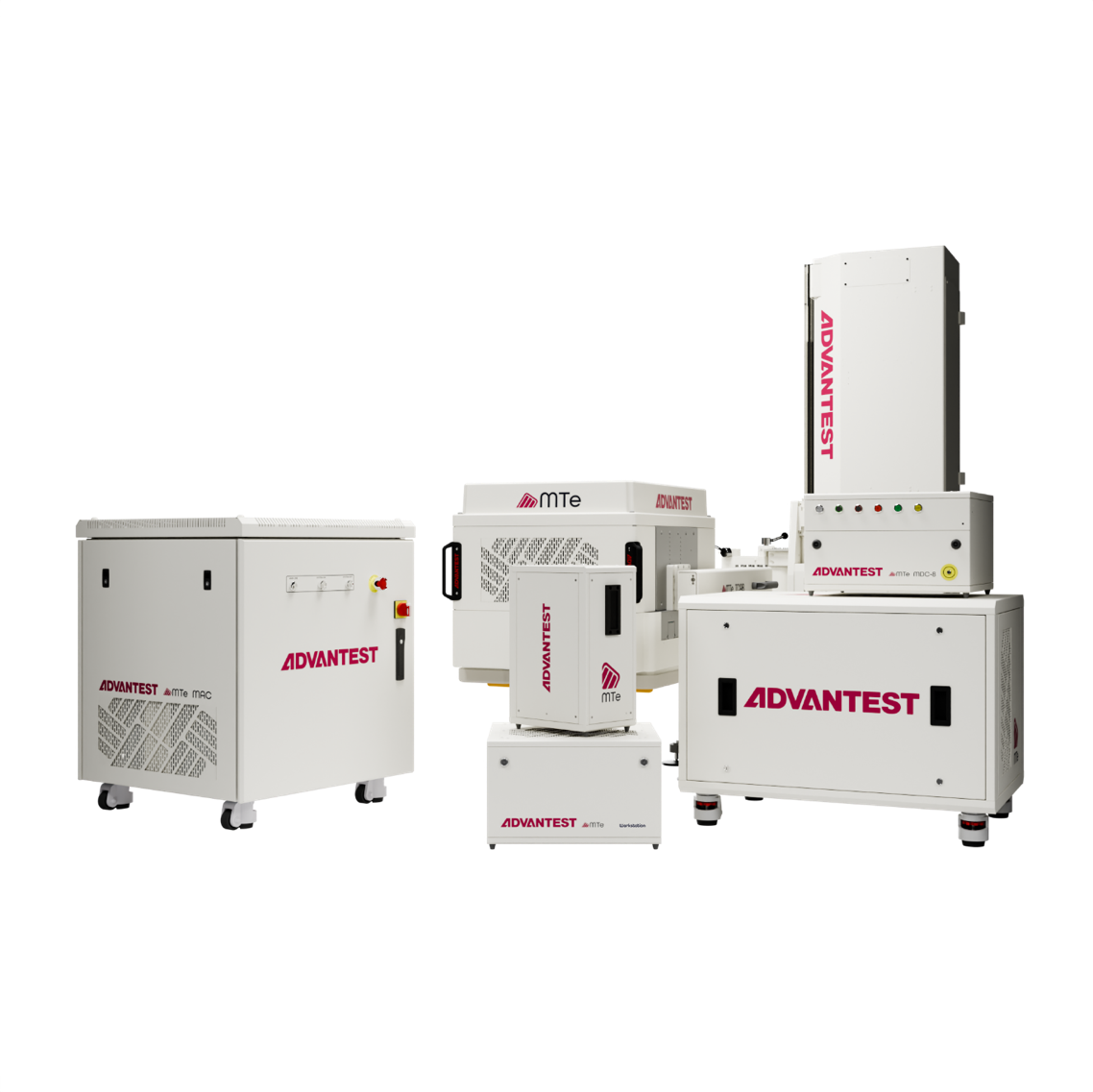
Advantest's MTe platform is developed to address these emerging requirements with a unified approach to power semiconductor testing. Instead of relying on multiple specialized systems, MTe can support high-performance testing from wafer sort through final power module validation within a single scalable architecture.
This helps simplify production flows while giving manufacturers the flexibility to adapt test strategies as devices evolve.
WBG devices such as SiC and GaN present challenges because of their extremely fast switching behavior and higher operating voltages. To capture these characteristics accurately, MTe platform incorporates high-speed digitizers and floating probes designed for the precise measurement of rapid switching events while minimizing parasitic effects.
At the same time, many modern power devices integrate digital control and monitoring functions alongside the power transistors themselves. MTe accommodates this shift by combining high-power test capability with configurable digital resources, enabling engineers to validate both electrical performance and digital functionality within the same environment.
The platform's modular design also helps manufacturers adapt as technologies evolve. Configurable racks and scalable instrumentation allow test resources to be expanded or reconfigured without replacing entire systems, helping protect capital investments while keeping pace with changing device requirements.
Software also plays an important role in improving test efficiency. MTe integrates with Advantest's FiTest environment, allowing engineers to develop, simulate, and debug test programs independently of specific hardware configurations. This capability simplifies test development and helps speed the transition from R&D to high-volume manufacturing.
As electrification accelerates across automotive, industrial, and AI-driven infrastructure, the demand for efficient and reliable power semiconductors will continue to rise. Meeting that demand requires not only advances in materials and device design, but also new approaches to testing that can keep pace with increasingly complex power electronics.